Visual Ads vs. Text Ads: Why Pictures Usually Steal the Show for Better Ad Performance

Are you ready to read convincing information on this topic?

Hey. Let's have a quick chat about something super important for anyone wanting their ads to stick and truly make an impact: using visual ads – like images and videos – versus just plain text ads. It’s a common question, whether you're new to advertising or have seen a million campaigns: what really boosts ad performance and gets those valuable clicks and conversions?

Now, don't get me wrong, well-crafted words are powerful. But if you're aiming to grab attention fast and make a memorable splash, visuals in advertising often have a serious, undeniable edge.

Why Our Brains are Hardwired for Visuals in Ads

Here's a simple way to think about it: our brains are naturally drawn to pictures. In fact, a lot of research suggests our brains can process image ads and video ads incredibly fast – some say up to 60,000 times faster than text! (You'll find different figures, but the core idea is widely accepted by experts like Lynell Burmark in "Visual Literacy"). So, when your ad appears, that visual element is often the very first thing someone notices, making an immediate impact even before they read a single word. This initial eyeball grab is where visuals usually win, hands down. Understanding the impact of visuals in advertising starts here.

The Engagement Factor: Do Visual Ads Get More Clicks?

And it doesn't stop with just first impressions. Just think about when you’re scrolling on your phone, perhaps through Facebook or Instagram. What makes you stop and look? Most of the time, it's an eye-catching photo or a snappy video, isn't it? This is why you’ll consistently see industry reports (and likely your own data if you're tracking ad engagement) showing that posts and ads featuring strong visuals can absolutely outperform text-only updates in terms of likes, shares, comments, and, crucially, click-through rates (CTR). We’re talking about a potentially massive lift in how much people interact with your digital advertising efforts. The question of "visual ads vs text ads" for engagement often leans heavily towards visuals.

Making Memories: The Power of Visual Marketing for Brand Recall

Then there’s the whole “making it stick” part – what people actually remember. Ever see an ad, kind of forget it, but then see the company’s logo or a familiar image later and it all comes flooding back? That’s the power of visual marketing at work. Pictures and videos help lodge a brand in our memories much more effectively. It’s like they create a more complete mental image, making it easier to recall later. This isn't just a guess; studies on memory often show that people remember a much bigger percentage of what they see (or see and read) compared to what they only read. For instance, it’s often cited that people can recall about 65% of visual information they’ve seen three days later, compared to only about 10% of written information (a concept supported by findings in John Medina's "Brain Rules"). This enhanced ad recall is a huge benefit.

Showing vs. Telling: The Benefits of Visual Ads

Plus, let’s be real, some things are just easier to show than to tell. Imagine trying to describe the amazing atmosphere of a vacation spot or all the cool features of a new tech gadget using only words. It’s a tough challenge! A stunning photo or a short, engaging video can do that job in seconds, conveying information and even emotion much quicker than a block of text. This is one of the most important benefits of visual ads.

We see clear proof of this in how different ad formats perform. Take Google Shopping Ads, for example – the tiny ad boxes in search results that display a product picture, price, and store name. If you're selling products online, these are like gold. They frequently achieve higher CTRs and often lead to more sales for those specific products compared to standard text ads. Why? Because people can see what they’re considering buying. Display ads (the picture-based ads that you can see in many websites) are also similar. A plain text banner might do okay, but if you use striking graphics, a compelling video, or even some fun interactive elements, you’ll usually see a significant boost in ad performance. Even in email marketing or on website landing pages, adding quality visuals generally keeps people interested longer and makes them more likely to take that next step.

When Text Ads Still Shine: It's Not Always Black and White

Now, before we say goodbye to text ads forever, let's be clear: plain text absolutely still has its place and can be a total rockstar in the right situations.

  • If someone types a very specific, urgent search into Google, like "emergency tyre repair near me now," a clear, concise text ad giving them exactly that information is perfect. They need info, fast.
  • For some businesses, especially those offering complex services or in B2B industries, text ads can be better for explaining all the crucial details.
  • And sometimes, you just need to get a quick, straightforward message out without any frills.

Plus, always remember this golden rule: test what works for your specific campaigns and audience. What’s a winner for one advertiser might not be for another. The data from your own A/B tests is the best guide to understanding what resonates most. I’ve seen reports suggesting that while visuals grabbed initial attention, sometimes text led to deeper engagement with detailed information – so context truly is key when comparing advertising effectiveness.

The Verdict: Leaning into Visuals for Impactful Advertising

So, what’s the main takeaway from our visual ads vs text ads discussion? If you want your ads to really grab attention, be remembered, and get people interacting, using strong marketing visuals is usually a very smart and effective strategy. Our brains are just wired to engage with them quickly.

This isn’t about never using text ads, but about understanding that image ads and video ads often pack a bigger punch and knowing how to use them wisely. Many times, the most successful ads use both – a fantastic visual paired with sharp, compelling copy.

Think of it like this: visuals catch the eye and can touch the heart, while well-chosen words can fill in the important details for the mind. Get that balance right, and you're on your way to creating ad campaigns that truly connect and deliver better results!

Missing Chat History in Google AI Studio

A Quick Tip: Where I Found My Missing Chats in Google AI Studio

I recently ran into a problem in Google AI Studio that I suspect others might be facing too: I couldn't find my recent chat history anywhere in the interface.

After some searching, I serendipitously happened on a link that solved the entire issue:

https://aistudio.google.com/library

This link happily listed out all my recent conversations. It was a huge relief. In case you were looking for your chat history too, now you know where to find it.

What Doesn't Work Anymore

You might have seen suggestions to check your Settings (the gear icon) for an "autosave" option. I was also pointed in this direction. However, after checking, I can confirm that this option doesn't seem to exist in the current interface. It appears to be outdated advice.

How to Save and Access Chats Now

So, if autosave isn't obvious, how do you save your work?

I found that there is a "Save" button located under the three-dots menu (), which you can find above your chat window. This is now the manual way to ensure your conversation is saved.

From what I can tell, the intended workflow is to save your chat, and then access it later through one of two places:

  1. The Library Link: The direct link I found (https://aistudio.google.com/library).
  2. Google Drive: When you save, a "Google AI Studio" folder is created in your Google Drive, and the chat is stored there.

So, I guess we can access our saved chats from the Google Drive folder or from that direct library link, though not directly from the main Google AI Studio chat screen anymore.

I wanted to share this directly because it wasn't obvious, and I hope it helps you avoid the same confusion I went through. 

Google Drive Google AI Studio Chats


Bluetooth on off Switch missing in Windows 10


Sometimes, what happens is that you are unable to switch the Bluetooth in your PC or laptop. Even if you are a professional, it gets you foxed. Because, you need a switch to switch it on and off, right? 

Your Bluetooth icon should be visible in the "notifications" tab that appears, when you press Windows+A shortcut on your keyboard.

If  it doesn't or is disabled, then follow the instructions given below to re-enable your Bluetooth again.

This is where we start. 
When you press on Windows+I, the following  screen is shown.
Windows Settings
Now, click on the "Devices" icon, to open up another screen.

This is the devices screen and you should be seeing "Bluetooth" with the provision to On and Off. You are here, because you probably aren't able to see it.

You are probably seeing the  image below. Notice the missing "Bluetooth".
Bluetooth on off toggle switch missing

Now, type Windows+S
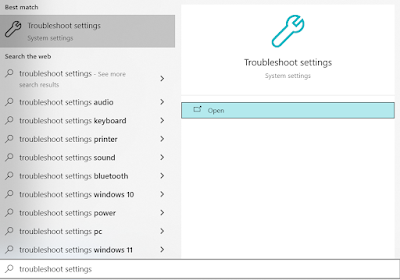
It will open  up a text box for you to type in. Enter "Troubleshoot settings" in there.
See the image below for reference.
Click on the  "Spanner" icon at  the top, to open the "Troubleshooting" page.

You should be seeing a screen similar to the one shown below.
Have you come till here? Great.
Do you see the "Additonal troubleshooters" link towards the bottom of the page? Click on it.
This opens up the "Additional troubleshooters" page, shown below.
Now, click on the "Bluetooth" icon shown below the "Find and fix other  problems". Then click again on "Run the troubleshooter".

You will now see another screen, while Windows tries to fix your problem.

At the end, it may take a few minutes, you should see the screen shown below.

You can now close your troubleshooter. To confirm that your Bluetooth issue has been rectified, click Windows+I, Devices, to see your Bluetooth enabled.

Hope you were able to sort this out.


Imagen 3: A New Era of AI Image Creation?


Imagen 3 from Gemini

Google has just unveiled Imagen 3, the latest iteration of their Gemini AI. They're making bold claims about enhanced image quality, impressive text generation, and visuals so realistic they practically leap off the screen. Having used Gemini before, I was curious, especially since the image generation hadn't exactly blown me away. This morning, as I logged into Gemini, a pop-up announcing Imagen 3 appeared, piquing my interest even more.

Now, what exactly is this Imagen 3? It's essentially a sophisticated AI model designed to create images from textual descriptions. Imagine typing in "a cat wearing a crown riding a unicorn through a rainbow" and having Imagen 3 generate a stunning, photorealistic image matching that exact description. That's the power Google claims Imagen 3 possesses. Beyond just creating images, Imagen 3 is supposed to be capable of generating accompanying text and crafting visuals with an unprecedented level of detail and realism.

I'm eager to delve into Imagen 3 and see if it lives up to the hype. If you've already had a chance to experiment with it, I'd love to hear your impressions. Share your experiences and insights – let's unravel the potential of this new tool together.

Rethinking Taxes: A Voluntary Approach for National Progress


The Broken System:

Let's face it, mandatory income tax feels... unnatural. We readily embrace gifts, but forced contributions often breed resentment. This negativity, some believe, taints the money itself, hindering its effectiveness.

A Call to Our Roots:

Imagine a society where taxes are seen as contributions, not burdens. Perhaps, like our advanced ancestors, we should explore voluntary taxation. Let people decide how much they want to invest in nation-building.

Why Mandatory Taxes Fail:

Many citizens suspect misuse of tax funds. Aadhaar, a system intended to curb corruption, can be seen as an admission of distrust towards the very people who fund the government. Wouldn't it be more empowering to trust their inherent honesty and patriotism?

Building Trust, Building Progress:

Focus on visible improvements – decent roads, reliable utilities, and honest officials. Let these be the testaments to responsible spending. When people see their contributions making a difference, their investment will naturally grow.

The Power of Positive Participation:

Voluntary contributions, fueled by positive thoughts, hold immense potential. Imagine a nation where every rupee donated signifies hope and belief in a better tomorrow. This optimism, unlike the negativity associated with forced taxes, will ensure the funds are used effectively.

A Smaller, Happier Contribution:

Think of it this way: 5% given willingly is far more valuable than 30% extracted grudgingly. As development flourishes, people will be more inclined to contribute even more.

Voluntary Taxation: A Bold Experiment:

Let's move beyond the "same old, same old" approach. Voluntary taxation is a daring experiment, one that could unlock a new era of citizen engagement and national progress.

The Cosmic Masala of Time: A Chai Shoppe Meditation on When and Why

Time. That grand, ever-flowing river we all bob along in, our little coracles propelled by the unseen current. We take it for granted, this precious commodity, until suddenly, the train has left the station, the rasgullas are devoured, and we're left staring at an empty plate, wondering where the afternoon went. But here's the thing, folks, time ain't the only factor at play. There's this other fella, this cosmic spice we sprinkle into the dish of life – timing.


Now, most of us understand time. It's the relentless tick-tock of the clock, the calendar pages flipping like a frantic roti maker. But timing? That's the secret ingredient, the invisible hand stirring the metaphorical pot. Take that fabled bullet train from Ahmedabad to Mumbai, a future marvel we all eagerly await. Booking your ticket on time is crucial, sure. But what about the timing of the train itself? Maybe the engineers hit a snag, a bureaucratic chutney causing a delay. Or perhaps, just perhaps, the delay saves you from a rogue samosa causing an emergency bathroom break right as the train pulls in. You see, timing is the universe throwing you a curveball, a gentle nudge in a direction you might not have considered.


Think back to that time you missed your flight to Goa. Devastated, you were. Beach dreams turning into dust. But then, a call – your booked hotel had double-booked your room, a leaky geyser situation causing chaos. Disaster averted! That missed flight, a blessing in disguise. The universe, in its own quirky way, had other plans for your Goan sojourn.


Here in India, we understand the importance of this cosmic masala. We wouldn't dream of starting a puja at an inauspicious hour, the wrong alignment of planets potentially curdling the sacred kheer. Likewise, a chai wallah wouldn't add the elaichi (cardamom) just any which way. The timing of each ingredient, the precise moment it hits the simmering milk, is what creates that perfect cuppa, the one that warms your soul and jumpstarts your day.


So, the next time you miss that deadline or an opportunity sails past, don't despair. Maybe the universe, that mischievous imp, is brewing something better just around the corner. Trust the timing, my friends. It might just be the secret ingredient that makes your life a truly delicious experience.


After all, wouldn't you agree? Life's a lot more flavorful when you have the right spices at hand, both time and timing, to create a dish that's both delectable and divine.

The Benefits of Google Ads for Your Business

 Demystifying Google Ads

Unveiling the Benefits of Google Ads for Your Business

(Chapter 1, Section 3)

Imagine you've decided to open a cozy bookstore, brimming with the magic of classic novels and the latest page-turners. You've curated a fantastic selection, but how do you get bookworms to discover your hidden literary haven? Here's where Google Ads steps in, transforming your bookstore from a hidden gem to a bustling destination for bibliophiles.

Why Google Ads? A Powerful Tool for Business Growth

In today's digital age, online visibility is key to attracting customers. Google Ads is an advertising platform developed by Google that allows businesses like yours to display targeted ads across the web – like search results, websites, and even mobile apps. But why exactly should Google Ads be your secret weapon for business growth? Let's delve into the treasure trove of benefits that can truly transform your online presence.

  • Reach the Right Audience at the Perfect Moment

Ever wished you could tell passionate readers exactly where to find that first-edition copy of "Pride and Prejudice" they've been searching for? With Google Ads, you can! By targeting specific keywords (like "first edition Pride and Prejudice"), your ads appear right when someone searches for those terms. It's like placing a personalized bookmark right in their online search journey.
  • Laser-Focused Targeting: Go Beyond Demographics
Traditionally, you might advertise in a local newspaper, reaching everyone – not just book lovers. Google Ads offers superior targeting options. You can target users based on demographics (age, location), interests (literature enthusiasts!), and even browsing habits (people who visit websites about classic novels). This ensures your ads reach the most likely customers, maximizing your return on investment.

  • Measurable Results: Know What Works and What Doesn't

Gone are the days of throwing marketing budgets into a bottomless pit and hoping for the best. Google Ads provides comprehensive analytics that track your campaign performance. You can see how many people saw your ad, how many clicked through to your website, and even how many people made a purchase. This data empowers you to optimize your campaigns, refine your targeting, and ensure you're getting the most out of your advertising spend.

  • Budget Flexibility: Stay in Control

Worried about breaking the bank with advertising? Google Ads allows you to set a daily or campaign budget, ensuring you stay in control of your spending. Even with a modest budget, you can create targeted campaigns that reach a significant audience.

  • Multiple Platforms, Maximum Reach

Your bookstore isn't confined to four walls – neither are your Google Ads! You can display your ads on search results pages (like Google Search), websites people frequently visit, and even mobile apps. This multi-platform approach ensures you reach potential customers wherever they are in the digital world, browsing the web or catching up on social media.

  • Boost Brand Awareness and Recognition

Even if someone doesn't click on your ad right away, seeing your bookstore's name displayed consistently can work wonders for brand awareness. Over time, repeated exposure builds brand recognition, making your bookstore the go-to destination for book lovers in your community.

  • Complement Other Marketing Efforts

Google Ads isn't a siloed marketing strategy; it works best when integrated with your overall marketing efforts. You can use social media campaigns to drive traffic to your website, where potential customers might have seen your Google Ad first. This cross-channel marketing approach amplifies your message and increases the likelihood of conversions.

By leveraging the power of Google Ads, you can transform your business from a hidden gem to a thriving hub for book lovers. In the chapters that follow, we'll delve deeper into creating effective Google Ads campaigns, from keyword research to crafting compelling ad copy. So, get ready to unlock the full potential of Google Ads and watch your business flourish!

How Google Ads Auctions Work


Demystifying Google Ads:

Part 2

How Google Ads Auctions Work

Welcome back, aspiring Google Ads expert! In part 1, we explored the different online advertising models (PPC, CPM, etc.) used in Google Ads. Now, let's peel back another layer and delve into the exciting world of Google Ads auctions – the core mechanism that decides which ads appear when people search online.

Let's consider your bakery, which is famous in your locality for the melt-in-your-mouth chocolate chip cookies. You want everyone to know about your delicious treats, but instead of relying on word-of-mouth alone, you decide to advertise in the local newspaper. Here's where Google Ads auctions come in.

The Bidding Frenzy: How Ads Vie for Attention

Imagine yourselves walking down a busy street downtown. The street is dotted with stores on the sides. Each of these stores have a nameboard and some of them will have interesting lights and other fancy aspects to capture your attention. You are walking down the street with an intention to buy a product. If you see a store that displays the product in your mind prominently, you consider, and then walk in.

Similarly, think of a Google Ads auction like an auction for displaying your ad on a search engine results page (SERP). Whenever someone enters a search term, like "freshly baked cookies," Google conducts a real-time auction among advertisers targeting relevant keywords. Several factors determine which ad wins the auction and gets displayed in a prime position:

  1. Your Bid: This is the maximum amount you're willing to pay each time someone clicks on your ad. It's like setting your spending limit at a physical auction. In our bakery example, you might set a bid of $1, meaning you're willing to pay a maximum of $1 whenever someone clicks on your ad after searching for "freshly baked cookies."
  2. Ad Rank: This score combines your bid with other factors like the quality and relevance of your ad and landing page. Going back to the bakery example, even if a competitor bids higher than your $1, your ad could still win the auction if your ad and landing page are highly relevant to the search term "freshly baked cookies" and have a strong Ad Rank. Google rewards relevant ads because they provide a better user experience.
  3. Ad Extensions: These are additional snippets of information you can add to your ad, like your phone number, address, or special promotions. Imagine including a call extension with your bakery ad, allowing users to call you directly from the search result page. This can give you an edge over competitors who haven't included extensions.

The Auction Outcome: Who Wins and Why?

The advertiser with the highest combined Ad Rank (considering factors like bid and ad quality) typically wins the auction and gets their ad displayed in the most prominent position on the SERP. But here's the good news: you don't necessarily need the highest bid to win. By crafting highly relevant and high-quality ads, you can outrank competitors even with a lower bid.

Beyond the First Place: The Bidding Waterfall

Google Ads auctions aren't just about who gets the top spot. There are multiple ad positions available on a SERP, and the auction determines which ads appear in each position. The cost you pay per click (CPC) can also vary depending on your ad rank and the competition for that specific keyword.

Let's revisit the bakery example. Imagine two other bakeries are also bidding on the keyword "freshly baked cookies." You might win the auction for the top spot with your $1 bid if your ad and landing page are exceptional. However, the other bakeries might still appear below your ad if their Ad Rank is high enough, even though their bids might be lower than yours.

A Win-Win for Advertisers and Users

This auction system benefits both advertisers and users:

  • Advertisers: You only pay when someone clicks on your ad (PPC model), making it a cost-effective way to reach potential customers actively searching for what you offer (freshly baked cookies!). You can also set daily or campaign budgets to control your spending.
  • Users: They see ads relevant to their searches and don't incur any cost unless they click on an ad. Google prioritizes relevant and high-quality ads, ensuring a positive user experience.

In Conclusion

Understanding Google Ads auctions is fundamental to your success in this dynamic advertising platform. Remember, it's not just about throwing the highest bid; it's about crafting compelling and relevant ads that resonate with your target audience. By focusing on quality, relevance, and strategic bidding, you can win the auction and get your ads in front of the right people at the right time.

As we progress, we'll delve deeper into crafting high-performing ads, keyword research strategies, and campaign optimization techniques to help you become a Google Ads whiz!

Understanding Online Advertising Models (CPC, CPM, etc.)

Demystifying Google Ads

Understanding Online Advertising Models

Welcome, aspiring Google Ads specialists! This chapter peels back the layers of Google Ads, unveiling the exciting world of online advertising. We'll explore different pricing models, understand how Google Ads functions within this ecosystem, and equip you with the foundational knowledge to navigate this powerful advertising platform.

From Curiosity to Mastery: A Common Google Ads Journey

Many embark on a Google Ads journey filled with initial intrigue, followed by potential frustrations, and finally, the realization that success requires knowledge and strategic application.

  • Intrigue: "Google Ads? Sounds interesting!"
  • Frustration: "Oh! Google Ads isn't working." or "They just want my money."
  • Mastery: "Google Ads is like any other skill. You need to learn it first." or "It's a double-edged sword. A great weapon, but know what you're doing."

If you're at the beginning of this journey, this chapter will be enlightening.

The Power of Targeted Online Advertising

Imagine running a bakery famous for its decadent chocolate chip cookies. Traditionally, you might advertise in a local newspaper. However, the online world offers a more targeted and measurable approach: online advertising.

Here, you can reach potential customers actively searching for what you offer. This is where Google Ads comes in. It's an auction-based advertising platform developed by Google that allows businesses to display targeted ads across various channels.

Understanding How You Pay: Online Advertising Models

Understanding different online advertising models is crucial for effective Google Ads usage. Here are three main models you'll encounter:

  • Pay-Per-Click (PPC): This is the most common model. You only pay when someone clicks on your ad. It's like paying in the bakery analogy only if someone walks through the door after seeing your ad. This model ensures user interest – they clicked because they're curious about your product (cookies!).

    • Example: You create a Google Ad targeting "freshly baked cookies." When someone searches for this term, your ad might appear above search results. You set a maximum bid (like an imaginary price per click) you're willing to pay if someone clicks your ad. Google conducts a real-time auction. Factors like your bid, ad quality, and landing page relevance determine your ad's position and visibility. If your ad wins and someone clicks, directing them to your website, you get charged.
  • Cost-Per-Thousand Impressions (CPM): This model focuses on impressions rather than clicks. You pay a set fee each time one thousand people (one thousand impressions) see your ad.

    • Example: Imagine placing an ad banner on a local news website with a CPM model. You might pay a fixed price for every thousand people who see your banner ad showcasing your cookies, regardless of clicks.

    While less common in Google Ads (focusing on clicks), CPM can be beneficial for brand awareness campaigns.

  • Cost-Per-Acquisition (CPA): This advanced model involves paying only when a specific desired action is taken, like a purchase or a signup.

    • Example: Imagine partnering with a food delivery app to promote your cookies. With CPA, you might pay the app only when someone successfully places an order for your cookies through their platform.

    CPA is great for driving conversions but requires a deeper understanding of campaign optimization and conversion tracking within Google Ads.

A Win-Win Ecosystem: How Google Ads Functions

Now that we've explored these models, let's understand how Google Ads uses them to create an advertising ecosystem that benefits both advertisers (like you) and users (people searching for cookies).

  • Advertisers: You create targeted campaigns, set budgets, and choose the most relevant pricing model (PPC for beginners) to reach your target audience. Google Ads provides detailed analytics to track your campaign performance and optimize for better results.

  • Users: When users search online, Google conducts an ad auction and displays relevant ads alongside search results. These ads are clearly labeled as "Ads" to avoid confusion. Users only pay when they click on an ad (PPC model), making online advertising a user-friendly experience.

By understanding these models and how Google Ads functions, you've taken the first step towards becoming a Google Ads expert. In the following chapters, we'll delve deeper into campaign creation, keyword research, ad copywriting, and the exciting world of Google Ads optimization!

Unlocking Google Ads Success with a High Quality Score

Unlocking Google Ads Success with a High Quality Score

Learn how to improve your Google Ads Quality Score to increase ad visibility, lower costs, and achieve better campaign results. This comprehensive guide covers everything from understanding the factors that affect Quality Score to actionable strategies for optimization.

Introducing Google Ads Quality Score

Your Google Ads Quality Score is a critical factor in determining your ad's position and cost-per-click. It reflects how relevant and useful your ads, keywords, and landing page are to users. A high Quality Score can significantly improve your ad campaign's performance.

Why Quality Score Matters

  • Higher Ad Rank & Visibility: A good Quality Score boosts your ad's position, increasing its visibility to potential customers.
  • Reduced Costs: High-quality ads often enjoy lower cost-per-click, stretching your advertising budget further.
  • Improved ROI: With better ad placement and reduced costs, a high Quality Score ultimately leads to a higher return on your ad spend.

Factors That Influence Your Google Ads Quality Score

  • Expected Click-Through Rate (CTR): How likely users are to click your ad based on its relevance and past performance.
  • Ad Relevance: How closely your ad matches the user's search query and intent.
  • Landing Page Experience: The relevance, usefulness, and ease of navigation on the page users land on after clicking your ad.

How to Improve Your Google Ads Quality Score

  • Targeted Keyword Research: Use tools like Google Keyword Planner to find relevant keywords with high search volume and low competition. Consider incorporating long-tail keywords that specifically address user intent.
  • Compelling Ad Copy: Craft clear, concise, and engaging ad copy that speaks directly to your target audience. Highlight the unique benefits of your product or service and include a clear call to action.
  • Landing Page Optimization: Ensure your landing page is relevant to your ad, loads quickly, is easy to navigate, and provides valuable information to visitors.
  • Ad Extensions: Use ad extensions like sitelink extensions, call extensions, and location extensions to provide additional information and improve your ad's visibility.
  • Continuous Monitoring & Testing: Regularly review your Quality Score and A/B test different ad variations to see what resonates best with your audience.


Click on "Search keywords" under "Audiences, keywords and content" to show this screen

Monitoring and Analyzing Your Quality Score

Keep a close eye on your Quality Score in your Google Ads account. Identify areas for improvement and implement the strategies mentioned above to enhance your score and overall ad performance.

Achieving a 10/10 Quality Score

While achieving a perfect 10/10 Quality Score can be challenging, it's achievable with diligent effort. It requires meticulous account organization, highly relevant keywords and ads, regular A/B testing, and a user-friendly landing page that delivers on the ad's promise.

Conclusion

Understanding and optimizing your Google Ads Quality Score is crucial for maximizing the success of your PPC campaigns. By focusing on relevance, quality, and user experience, you can achieve higher ad rankings, lower costs, and ultimately drive better results for your business.

Two Reasons Google Ads Lead Form is Rejected

Two Reasons Google Ads Lead Form is Rejected

An Investigation on Why the Google Ads Lead Form in My Google Ad Got Rejected.

I just found out two reasons Google Ads lead form is rejected by Google. Before I get to the point, here is the story. [If you are in a hurry, skip to the last paragraph of this article.]

I know from my experience that Communication or rather the lack of it, is the Reason for most, if not all of the World's problems.

Google ads, is a case in example. :-)

We all know Google is making billions through its ads and its communication is impeccable.

But, wait, don't get into hasty conclusions. Enter Google ads.

I do not claim to be an expert in Google ads. But, we generally use it to promote our business. I assume you know more than a little aboug Google ads. Hence, there is no introduction offered here.

So, recently, we created a responsive search Google ad, with a lead form to try and capture some leads.

It was an ad to promote one of the largest wedding venues in Chennai.

What is a Google lead form?

A Google lead form is one of the extensions to a Google ad. Here, a prospect can fill in their contact details, to know more about the product/service on display.

Sitelinks, callouts, structured snippets, and one-click calling are other extensions. Like these other extensions, lead forms are also shown directly under search ads.

For each campaign you need to create a lead form, if required. Of course, a lead form thus created could be used in multiple ad campaigns.

Filling the Google Ads Lead Form

Here, the lead form had a "Headline", the "Business name", a "Description".

I filled in all three.

Of the many listed, I chose three contact details, such as name, phone number and city, for the visitor to fill in. These are by default, pre-filled automatically.

Lead Form Qualifying Question

From my earlier experience of using Google lead forms, I found out the disadvantages of a plain form. Without a qualifying question, you generally tend to attract a lot of junk enquiries. I do not know the exact reason, though.

To avoid that I included a mandatory qualifying question, which will ensure that the visitor indeed posted the enquiry. He/she is forced to choose an answer from a dropdown, or fill in a text box with some information. I assumed that just the submit button without the qualifying question was the reason for the junk enquiries.

Most of them we called, would say, "What enquiry? I didn't post any enquiry. Call again and I will report you!". Paying money and inviting trouble :-)

While Google lead forms may appear to be a convenient solution for lead generation, there is a lesson here. It is that the quality of leads collected probably isn't as high as with a personalized post-click landing page. By having a well-designed personalized page experience, we can achieve the same results as Google lead form extensions can. Furthermore, a dedicated page gives prospects a more comprehensive introduction to the offer and your brand. It gives them relevant details to assist in making an informed decision.

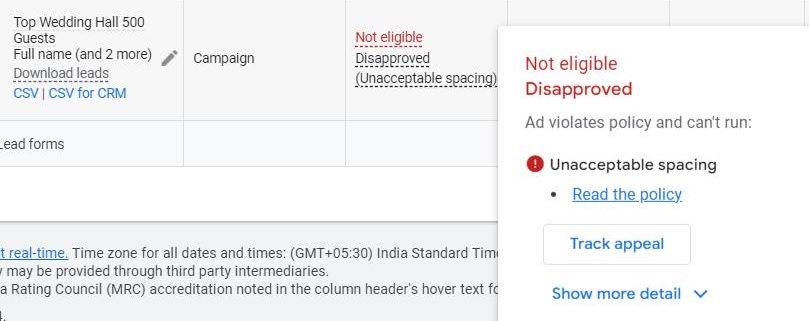
Once I filled in all the requisite details, I saved the form. And waited. Google Ads responded after a little while with the message

Not eligible
Disapproved
Ad violates policy and can't run:
Unacceptable spacing

What Did I Miss Out On?

I clicked on "Read the policy". Here's the link to the lead form requirements. I went through it with a fine toothcomb and couldn't find anything untoward in my lead form content.

Now, I did not give any extra spacing or miss a space between words as given in the example in the policy. So, what was the real issue? It looks like Google ads wants us to find out the reasons, the hard way.

Google could have told us that there is a problem with the Headline. Or the qualifying question, or wherever. But, it chose to just limit the response to "Unacceptable spacing", that's all.

I started looking at each word and letter individually, to rule out any error. I checked for a spelling mistake or an extra space that I might have put in there. At the end of this exercise, I found that I was using an exclamation mark "!". Could that be the problem?

Assuming that the "!" could be the culprit, I removed that. And submitted the ad. After sometime, I found the ad was again "Not eligible".

Not finding anything untoward, I clicked on "Appeal" and disputed the decision.

Again no luck. Rejected again. Totally confused now, I assumed that the messaging was grammatically incorrect.

I wrote the head line "Top Wedding Hall 500 Guests", in order to adhere to the 30 character limit. So, I changed it to "Top Wedding Hall in Chennai" and submitted again.

Two Reasons Why Your Lead Form Could Be Rejected

Voila! The ad got through. So, these are the culprits. The insight here is that you cannot use the exclamation mark(!) and the statements you make in your ads, have to be grammatically correct.

And, finally my Google ads lead form finally got approved.

Revenge and its Consequences

REVENGE AND HOW IT HURTS US MORE


Why should I not take revenge?

Revenge seems to be a natural response to injustice that seems to target us. This is what we do and have been doing since inception. 

Did we think for a moment that why should we alone be targeted for good or bad, in a billion strong population?

Did we stop a moment an think why only a few hundreds or thousands are affected in a natural disaster and not all?

Did we pause to ponder that when millions are driving on the roads, why only a few are involved and get seriously hurt in accidents?

Why do people cause grievous hurt to themselves and others for no apparent reason?

To understand this, we need to understand that there are multiple levels of consciousness in nature.

Nature by its nature, cannot do us any harm by itself. It is designed to be protective of us. And, it is in constant communication with us telling us to do a certain thing or not to proceed with a certain thing. But, as with any case of modern communication, it is not enough that the transmitting cell is working. If the communication is to be complete, the receiver cell also has to be working 100%, otherwise the message is not received well at the receiver's end.

It is the same case with nature. Nature communicates with us in many ways, wanting to help us all irrespective of the goodness, badness or neutrality of our activities. That is the nature of nature or the cosmos; it is full of benevolence.

But, what happens is that based on our past and present actions, some of our antennae or receptors are blocked and/or faulty. In such cases, we are not in a position to receive messages from the cosmos. When this happens, we are prone to error and one such error cascades into a series of errors culminating ultimately in sorrow. This may be related to health, family, business and other activities.

To regain control of our life, now and beyond, we need to follow the nature of nature. We need to change ourselves to mimic nature. Nature is not partial. Whatever is in nature is for everyone of us. Nature does not hurt anyone. Whatever is in nature is for the benefit of not just humanity, but for all beings in nature.

What happens when we take revenge?


Revenge is an action that is against nature. In fact, any reaction is an unnatural action. We can be pro-active, but not reactive. Reaction is a destructive mechanism. So, reaction is better avoided. Let action pass through us as if it did not happen. Or, it can be tackled gently without violence.

When it gets to a stage where somebody will get hurt, we should never go for it.

When we hurt somebody, in whatever little of big way, it gets registered in our memory. It is like taking a loan. The loan amount and the repayment amount including interest is instantly recorded. At the right time and right place, we will be repaying the amount. There is no escape.

When we keep doing hurt on others, the ability of our body to lock on to the frequency of nature's helping wavelength is affected. For some it is less and for others it is affected more.

Revenge affects us in small ways and big ways.


We all are aware that incidents happen in a fraction of a moment. If one of the participant is late even by a moment, then that incident does not happen.

Take for example, we are following a bus. The bus suddenly takes a turn and blocks our path. As we are cursing the bus driver, from the bus gets down our friend whom we have not seen in decades. 

We would have missed her if we had started a bit late or early. If we had started early, we would have passed the bus and had we been late, the bus would have passed us. This small happiness is the  result of a good deed in the past.

In the same manner, somebody is pushing the bike to the nearest petrol pump, in the middle of the night. There are many things that could happen here. Another biker, or an autorickshaw, could stop by and tow you to the nearest petrol station.

Or, some thief on his way home, could stop and rob your purse, leaving you in further distress.

At the end of it all, we attribute it to good or bad luck. But, that is not the case. It is because, we are not in control of our such memory; we have no recall of the past. 

We have to understand that whatever happens, is deemed to happen. But, whatever will happen in the future, is in our hands.

So, beginning now, forget that revenge.

Why is there poverty and suffering in the world?

Poverty and Suffering in the World

Poverty and suffering is pointed out by the atheists to prove that God does not exist. 

Before we try and find the reason for the above problem, we should understand how the world works, how the Universe works.


Whether God exists or not, the Universe operates upon certain rules.

Once we understand how the Universe works, it becomes easy for us to know the answer.

So, How does the Universe work?


The Universe works on the cause and effect principle. When we do a certain thing, we get something back in return. It is true for even the simplest of thought, speech and action by us.

So, how do we prove that Karma or Cause and Effect works?

To find out if a certain thing works or not, the use of probability is used. To know if a certain thing will work, a miniature of the same action is tested to find out if it will work. Generally, that is how it is done. 

For example, we all know that when we make a deposit in the bank, we get interest in return. We all know that when we say good things to people, we make them happy and get their good will in return.

We also know that when we take a loan from the bank, we have to repay it, with interest. We know that when we speak harsh words to people, we kindle their anger with the possibility of getting hurt by them.

We know that when we sow a mango seed and water it till it grows, we are presented with a fruit bearing tree for a life time. While we would have sown the mango seed, the fruits of the tree would probably be enjoyed by our children and grand children.

We all know that when we build a company that makes its customers happy, their reference brings us more customers and so on.

So, we see that in everyday life, there is enough proof for us to understand that our actions define the results that we get in the future.

Now, the question arises. Why is somebody who is a good human being put to so much suffering? He has not even had a harmful thought on other people.

The Cycle of Birth and Death


This brings us to the topic of continuous experiences. When you run a company and run into losses. You close the company down and open another company. You still are liable to make good the previous company's payments, isn't it?

It is the same concept here. We are all in the continuous process of birth and rebirth.

We have no clue about who we were, what we were doing in an earlier experience, wherever in this world we were.

So, the only thing to do is to ensure that we put a full stop to this suffering right here. Since, we know that our actions define our future experiences, we have to ensure that our present actions do not harm anybody through thought, speech or action.

Essentially, our present sufferings are the interest we are paying on our past loans. Once the interest and principal is paid in full, we can again start with a clean slate.

Based on how Nature works, poverty and suffering in the world is a result of the past actions of those in suffering.

To understand this, we should know that every person is not in poverty and suffering, literally. Some of us, will have enough money and wealth, but will not be able to even eat and enjoy material life properly, due to medical and other compulsions.

In the minds of those people, a poor but healthy person is more blessed than them. It is relative.


So, What do we do to alleviate poverty and suffering in this world?


For our part, we can try and alleviate the poverty and suffering of those we encounter in our day to day lives, by helping them out, as a repayment of our interests and create a deposit for the future.

And also by not indulging in anything that is physically or emotionally harmful to others, either by thought, speech and action.

How can we reduce the running costs on AWS Server?

Amazon Web Services

Cost Reduction or Saving money on AWS EC2 Instance


In AWS EC2 pricing, there are three main elements such as an Instance, a Snapshot and a Volume.

So, ec2 instance pricing includes the cost of each of these resources consumed, such as hard disk space, bandwidth and is costing us money on a daily basis.

The idea is to take a backup of our unused data and source and move them into cloud storage and then delete the dormant instances, snapshots and volumes.

This will result in an immediate reduction in our running costs of AWS EC2 instances. I will briefly explain how we do it, here.

Logon to our Amazon Web Services console and choose EC2.


What are the EC2 elements that cost money?


Amazon Web Services EC2 Saving Money Dollars
In the EC2 dashboard main screen, among other things, we will see Running Instances, Snapshots and Volumes. As indicated, these things cost us money, by the hour. Of course, Elastic IPs also cost, but only if we aren't using them.

Of these, the instances will cost us according to the server we have chosen, micro, small, medium, etc. The storage that we use for the server (OS and data) is also on cost. Further, the bandwidth used, for uploading and downloading source and data is also at a cost.

Technically speaking, these servers we hire, cost us only if we use them. But, there is a catch. Since, we are using storage, these storage spaces are payable, whether we use them or not. Even though the costs are not too high for storage, if we are not careful, we may end up paying dollars unnecessarily.


Removing dormant instances and volumes


As a first step, we will have to identify the volumes that are used by our running instances.


In the above, you may see that there are 2 instances, but three snapshots and 5 volumes. This may indicate an excess of 1 snapshot and 2 volumes. These may be noted, evaluated and if found not required, deleted.

Once identified, we will carefully note them down. We do not want to delete any running instances or storage spaces, unintentionally.

For this purpose, we will make a note of the instances and link them to the volumes connected, using the instance id.

Once they are identified, the next step is to make a note of our stopped instances. Every instance may be linked to a volume or storage area in the network.


If we find that the above 3 stopped instances are no longer required, we may terminate them, along with the volumes that  they are linked to, to reduce our aws bill.

Once we have identified the instances and volumes that we do not require, we can delete our instances, along with the volumes with data and sources.

If, during the creation of the instances, we had chosen the volumes to be not deleted automatically upon termination of the instance, the volumes will not be deleted on deletion (termination) of the instance.

Under such circumstances, the orphan volumes may need to be removed independently, later.

Alternately, we may detach (right click on the volume to be detached and you will see a context sensitive menu) the volumes individually and then delete them.


AWS EC2 instance review


We will have to do this preventive maintenance, every time a new instance and/or volume is created and the old instances and volume are stopped and lying unused.


These cost us money and thus the savings on AWS EC2 instances through maintenance, may be substantial over a period of time.

Visual Ads vs. Text Ads: Why Pictures Usually Steal the Show for Better Ad Performance

Are you ready to read convincing information on this topic? Hey. Let's have a quick chat about something super important for anyone want...

Most Popular

Copyrighted.com Registered & Protected DWYE-NHTO-NBNH-7FFM